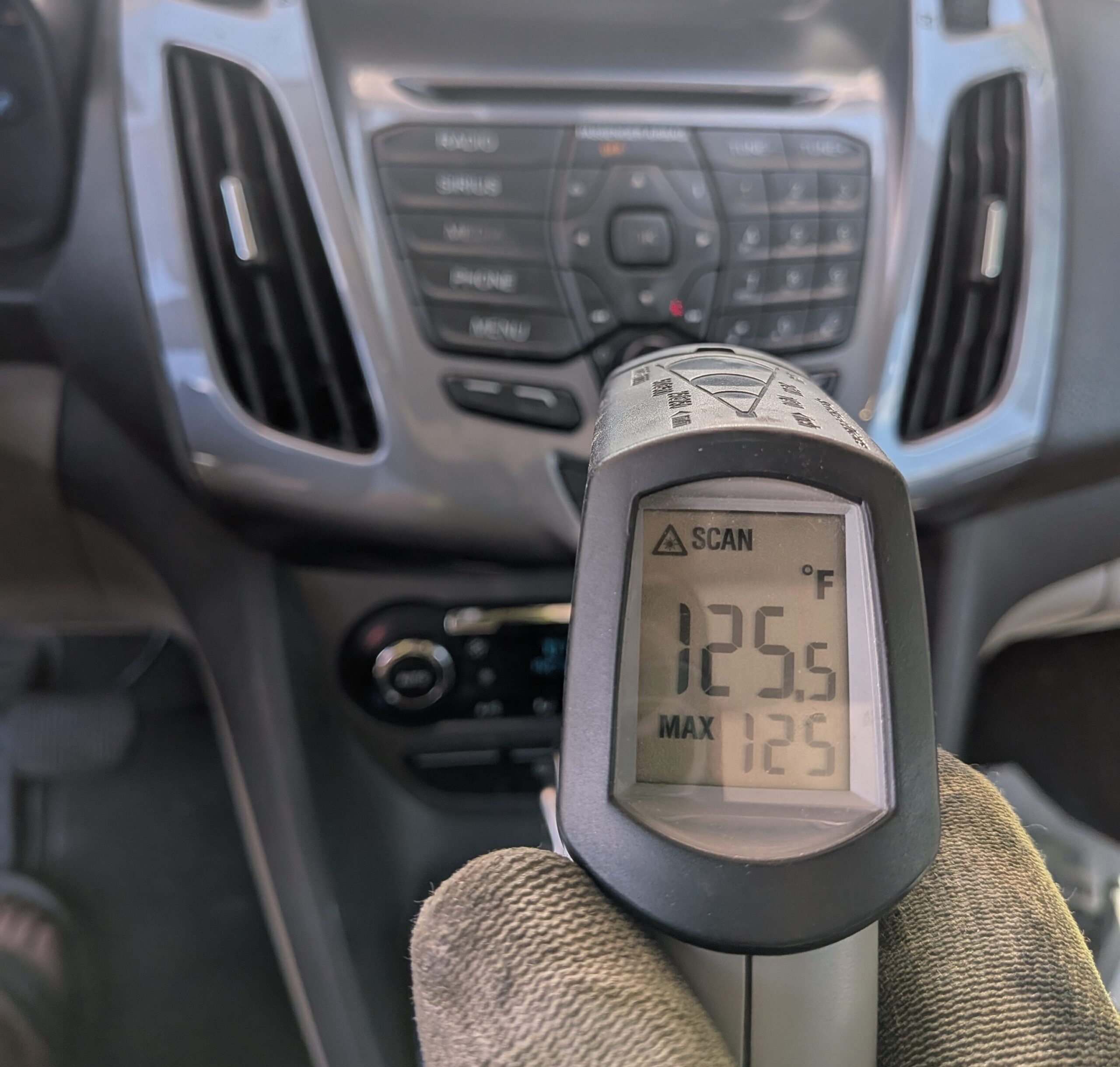
When you live in Texas, your car’s air conditioning is a really important system. When something goes wrong, not only does the temperature go through the roof, so do the repair bills. I had replaced the entire system on my project car (1994 Honda Civic Hatchback) after one sweaty summer driving it. That particular month was between selling a truck I had and purchasing a commuter car.
I finally settled on a fairly unexciting option: a 2007 Toyota Camry. It has the four cylinder engine (good on gas), cloth seats (not so hot in the summer!), and is basically invisible in its Silver paint. It has never excited me, but it sure had ice-cold air conditioning! I used to tell people that the AC was my favorite feature of the car.
If you have a sense of foreboding, you’re not alone. Sure enough, in July, after getting back from a week off something wasn’t quite right with the ol’ Camry.
(I feel it necessary to include this disclaimer: this website is for entertainment purposes only! I am not a professional mechanic. The methods I use may be completely wrong and/or dangerous. Please seek professional help with anything and everything, especially if you are in doubt about your own abilities. Do your own due diligence and research. Working on cars is extremely dangerous. I am not responsible for any loss of life or limb or property.)

The Rather-Sweaty-No-Good-Day
At the time, I had a 30 minute commute. Pretty easy compared to what I’d done growing up in Southern California, and here in the Dallas Forth-Worth Metroplex, traffic is generally moving quickly. Well, one Monday (it’s always a Monday isn’t it?) I noticed that the outside vents were noticeably warmer than the center ones on the drive in. Like, warm enough it was, “let’s fill up the water bottle and coffee mug with ice and water before heading out.”
You know, a touch schweaty.
I called my local repair shop and dropped it off that afternoon. Tag, the Civic was in as the daily driver! I didn’t have long to wait for the verdict for the shop, however. The call came the next day, and the verdict was straightforward:
My Camry’s compressor had given up from the inside out, which often results in metal shavings being loosely distributed between the compressor and all the other bits after it. The words “catastrophic internal failure” may have been used.
The fix? Nearly $4,000 would be required to bring it back online.
Math and How Much is Too Much to Spend on an Old Car
Eagle-eyed readers may have noticed the tag hanging in the window of the Camry from the photo above: I bought it for about $8,000 and had owned it for about three years at this point.
This dilemma is one that countless others have faced, and perhaps you’re here reading this because you are in the same place. Unfortunately, there is no basic math problem that will tell you when to fix a car or when to cut your losses and walk away.
Here’s how I approached the problem:
Option 1: Have the Shop Fix It
Pros:
- Fastest path to working AC on the car
- Warranty for work performed
- I don’t get my hands dirty
- No huge loss from “dumping” a broken car
Cons:
- $4,000 is a lot of money (for me)
- $4,000 is nearly half the purchase price of the car
- $4,000 is roughly the KBB Private Party value for this car
- UGH
As you can see, forking over the $4,000 was not an appealing choice for me. Thankfully, I had the option of driving my project car for a while, so I wasn’t dealing with the extra elements of paying for Uber rides to work, renting a car, or having my wife drive me.
Option 2: Cut and Run (aka, trade-in to dealer for another car)
Pros:
- Quick-ish solution
- “New” car
- I don’t get my hands dirty
Cons:
- Three years ago the $8,000 Camry was on the cheaper end from a reputable dealer
- $8,000 is more than $4,000
- Trading in a broken car is likely to get me $1,000 (give or take) in value from a dealer
- Another used car could also be harboring hard-to-see issues
- Other than the AC issue, the Camry had no other major issues
If the AC was the biggest item on a long list of other existing problems I was ignoring (hey, I’ve been there…) then that would have been an easy decision. Unfortunately for me, as a person who loves to buy cars, the Camry had no other major issues. Having purchased quite a few cars over the years (I’ll cover this in a future post) I was well aware that a used car was likely to not be a clean slate.
Option 3: Do Nothing
Pros:
- Doesn’t cost a thing (at least until the registration comes up, or insurance)
- I had a third car I could commute in
- In a pinch, I could have my wife drive me to work
- I could wait and drive the car only in “heater weather”
- Just drive it without AC (some people pay to sweat!)
Cons:
- Nothing is actually getting fixed or solved
- Short-term option, since eventually insurance and registration are going to come up
- I live in North Texas, so “heater weather” is a much shorter period of time than many other places
- Summer is HOT
- Driving without AC in Texas is a recipe to arrive sweaty everywhere most of the year
Honestly, this is what I did for a few weeks. Nothing. Nada. Just parked it in front of my house and looked at it out the office window. I had the Civic, and my wife’s truck is running great, so I had options for getting around. The Civic is thirty years old though, and being a project it’s a little rough around the edges. Just abandoning the AC and making the Camry a “winter beater” was just not a viable option either, since winter is so much shorter in Texas than in many other places.
Option 4: Fix it Myself
Pros:
- Air conditioning works again!
- About $400 in parts
- I already have most of the tools needed thanks to the repair on the Civic
- I have a garage to work in
Cons:
- I have to get my hands dirty
- Potentially dangerous
- I have to work on a car in Texas in the summer (garage isn’t insulated or conditioned)
- Having only basic tools means the repair could be short-lived
- Additional fixes are on me, and I’m paying shop rates to have the AC pumped out and filled
Eventually, this is the course I settled on for my situation. Emotionally, I wanted to get rid of my unexciting commuter car. Logically, $400 is less than $4,000. Indeed, $400 is far less than buying a new car. Since I had options for getting around, I was able to buy online and save a lot of money on the components I would need to replace. If you need it fast, you’re paying a premium at a brick-and-mortar store. If you can wait, like I did, you could save hundreds on parts.

How to Make a Decision – Not an AC How-To Guide
Unfortunately for some readers here with an AC problem with a 2007 Toyota Camry, this is not a how-to guide. This is merely sharing what I did in my particular situation. My path may not work for you, and that’s okay.
DIY Option
My recommendation if you are determined to do this work yourself is to spend a lot of time on YouTube watching much better mechanics do their thing and share their process. One thing you should absolutely do is pay a repair shop to properly evacuate your refrigerant. The refrigerant in newer vehicles is much less bad for the environment (and your health) when released than it used to be, but it’s still not a good idea to pop off a hose and vent it out on purpose. That’s just wrong, and is probably illegal in many places.
Repair Shop Option
Shop around and get more than one quote, especially for big jobs. It doesn’t hurt to call several repair shops to see how they price the same work. Also inquire about whether a shop will warranty their work, and for how long. It’s also worth getting a second opinion to make sure the identified problem is indeed the problem. In my case, I’ve had this particular shop work on multiple cars over a 3 year period. They’re proven themselves to be trustworthy. They’re also not cheap.
Key Questions to Consider
Here are the key questions that helped me make my decision. Be honest with the answers:
- Do you have the mechanical ability and tools to do this work yourself?
- What’s your car worth? What’s trade-in for one in decent shape?
- Is now a good time to buy a new car?
- How much is it costing me to delay this repair?
Take some time, if you can, to weigh the pros and cons of the options before you. Urgency, and needing your car back as soon as possible, is often a recipe for having to spend more money. Depending on how vital it is to have reliable transportation might make situations like leasing a better idea than owning a string of lower-priced cars. If you’re in a situation similar to mine, and you can drive another car and do the work yourself (or have a relative/friend do it, or help with the repair) then you can probably pursue the DIY path. And if you happen to live somewhere with a whole lot more “heater weather” than I do, then rolling down the windows in the summer and sipping an iced drink might be the right path forward.
Good luck and God Bless as you consider what to do next!
-Austin